
When Do I Need a Bookkeeper? (And Do I Even Need One Yet?)
If you’ve started making money on the side — or you’ve just hung your own shingle — you’ve probably asked some version of this question. And the answers you find online tend to be either “yes, immediately” or some checklist of revenue thresholds that doesn’t match what your business actually looks like.
The honest answer is more useful than either of those: yes, from the beginning — but the kind of relationship you need with a bookkeeper depends on where your business actually is. It evolves. And for some businesses, it never has to evolve much at all.
Here’s what that looks like in practice.
The video walks through the full lifecycle in plain language. The rest of this article carries the same argument in writing, with a few honest refinements that the original video didn’t have room for.
Your financial team changes — your bookkeeper doesn’t
A business owner needs different kinds of financial help at different times. Funding plans. Tax strategy. Cash management. Selling the business someday. Each of those is a different kind of expertise, and the specialist who’s right for one isn’t necessarily right for the others.
But there’s one role that shows up at every stage: the bookkeeper. Because no matter what the CFO or the CPA or the wealth manager recommends, somebody has to actually do the work. Track the money. Keep the books accurate. Make sure the numbers are right when anyone asks. That’s the bookkeeper — the one constant across the whole arc.
That’s what this diagram shows.
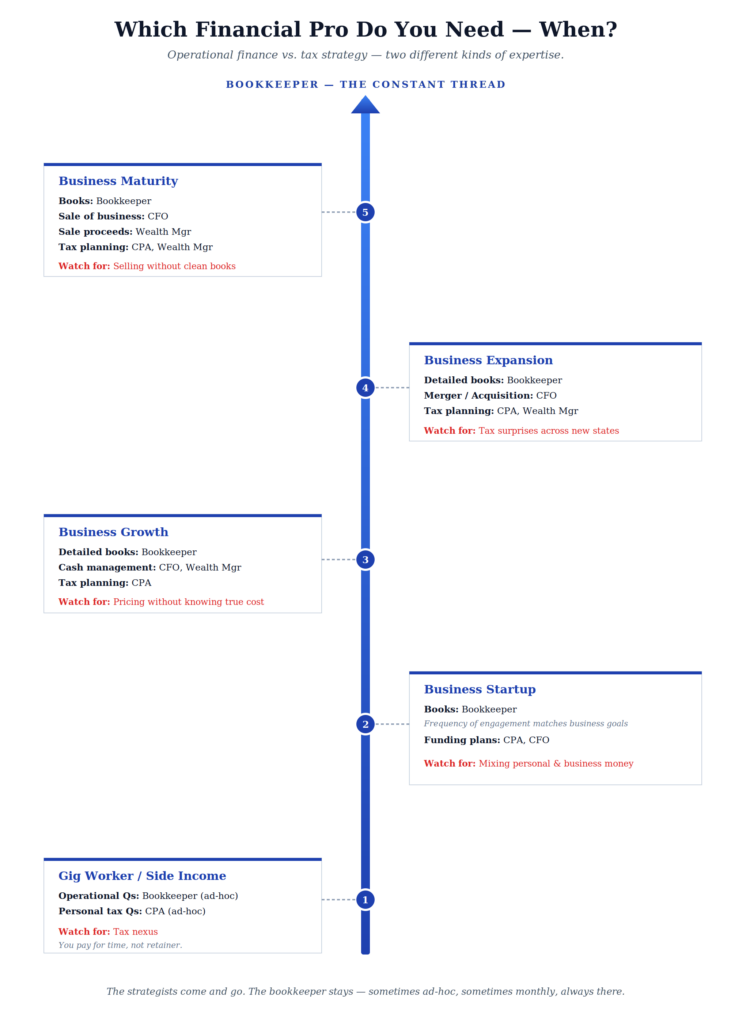
The bookkeeper runs the full height of the diagram on purpose. The strategists branch in at the stages where they’re useful. The bookkeeper stays.
Stage 1: You’re a gig worker or side-income earner
You sell a few things on Etsy. You drive for a rideshare. You consult for a couple of friends on weekends. You’re making money — but you don’t really think of yourself as running a business yet.
At this stage, you probably don’t need a bookkeeper doing your books. What you need is access to someone you can ask questions of when something feels uncertain.
The risk at this stage isn’t bad bookkeeping. It’s not knowing what you don’t know. Tax nexus is the classic example — at some point, your side income crosses a threshold that triggers tax obligations you didn’t know existed, and the way you find out is when a state or the IRS sends you a notice with penalties attached. By then, the cheap version of the problem is no longer available.
The fix: find a bookkeeper you trust and a CPA you trust, and treat them as ad-hoc resources. Pay for an hour of their time when a question comes up. Operational questions — “do I need to register a business?”, “should I be collecting sales tax?”, “am I supposed to be tracking this separately?” — go to the bookkeeper. Personal tax questions — “how does this side income affect my return?”, “should I be making estimated payments?” — go to the CPA. You’re not on a retainer with either. You’re paying for expertise when you need it. That ad-hoc relationship is worth a lot more than people realize. A thirty-minute conversation with a real bookkeeper at the right moment can save you a year of penalty interest later.
Stage 2: You’ve started a real business
You’ve registered. You’ve opened a business bank account. You’re making real money — and you’re doing it through a real entity, not just adding 1099s to your personal return.
This is where the bookkeeper relationship usually starts to look like an actual engagement, not just occasional calls. But not always. Some businesses stay one-person operations permanently — solo consultants, single-operator service businesses, freelancers who don’t want to grow into a team. For them, ad-hoc bookkeeping help may be the right fit forever, and that’s a legitimate choice.
The honest framing is this: the frequency of your bookkeeping engagement should match the goals of your business. If you’re growing into something bigger, you’ll outgrow ad-hoc fast and need monthly. If you’re staying solo on purpose, you may never need more than ad-hoc. In fact, many businesses stay as one-person owners and they can learn QuickBooks themselves with an ad-hoc bookkeeping resource — and the bookkeeper is there if they notice a problem.
At this stage you’ll also want help with funding plans if you’re raising capital or applying for a loan — and that’s where a CPA or part-time CFO becomes valuable. (The Small Business Administration’s SCORE program offers retired executives who’ll do this work for free; worth knowing.)Watch for:mixing personal and business money. This is the number one bookkeeping mistake new business owners make. It’s easy to fix in the first month and a nightmare to fix in year three.
Stage 3: Your business is growing
You’re past startup. You’ve got customers who come back. Revenue is climbing. Maybe you’ve hired someone, or you’re about to.
The bookkeeper’s job here gets bigger — detailed books, not just transaction tracking. You start needing to understand the patterns in your numbers, not just the totals. Where your margin actually is. Which customers are profitable and which aren’t. What your cost structure really looks like.
This is also where cash management matters. Growing businesses run out of cash even when they’re profitable on paper, because growth eats cash before it produces it. A CFO or wealth manager can help here. And a CPA’s tax planning becomes more strategic — proactive, not just compliance.Watch for:pricing without knowing your true cost. Many growing businesses set prices based on what competitors charge or what feels reasonable. Then they grow, and the more they sell, the less they make, because the price was wrong all along. Your bookkeeper sees this pattern early — if you ask.
Stage 4: You’re expanding
New product lines. New markets. New states. Maybe an acquisition.
At this stage the CFO earns their fee — they’re who you want when you’re evaluating whether an acquisition makes sense, or how to structure a new business line, or whether you can afford the next hire. The CPA’s tax planning gets more involved too, especially if you’ve crossed state lines and triggered new tax obligations.
The bookkeeper is still keeping your books — but now they’re managing more complexity. More accounts. More categories. More questions from the strategists who need clean data to do their work.Watch for:tax surprises across new states. This is the grown-up version of the tax nexus problem from Stage 1. New states, new products, and new sales channels each carry their own tax obligations, and they don’t announce themselves. The bookkeeper and the CPA together are your defense.
Stage 5: Your business is mature
You’ve reached the stage where the conversation shifts from growing the business to what happens to the business eventually. Sale. Succession. Transition.
This is where the wealth manager becomes central — not just for your investments, but for what happens to the sale proceeds when you eventually exit. The CFO helps with the sale itself. The CPA helps with the tax planning that surrounds it.
And the bookkeeper? Still there. Still keeping the books. Because the cleanest exit conversations happen with clean books — and the messy exit conversations happen with messy books.Watch for:trying to sell with books you haven’t taken care of. The books you neglected for ten years become the bottleneck the year you try to exit. Buyers won’t pay full price for a business they can’t see clearly. Clean books are a multiplier on your sale price — and you don’t get to clean them up in three months. In fact, clean books are your biggest asset in a sale.
So — do you need a bookkeeper yet?
Yes. But maybe not the way you were picturing.
If you’re a gig worker or side-income earner, you need a bookkeeper you can call when you have a question — not one who does your books every month. If you’ve started a real business, you need a bookkeeper whose engagement frequency matches your business goals. If you’re growing, you need a bookkeeper who can see patterns, not just transactions.
The strategists — the CPA, the CFO, the wealth manager — come and go depending on what’s happening that year. The bookkeeper stays.
That’s the honest answer to the question. Want a sharper look at what bad bookkeeping costs you when you actually need the books? Here are 5 mistakes that get business loans denied.
Five questions to ask yourself
If any of this hit close to home, here’s some homework. Sit with these for a few minutes before you do anything else.
- Where are you on this arc right now? Be honest — gig worker, real-but-solo, growing, expanding, or mature?
- What’s the most recent question you wished you’d had someone to ask? That’s the kind of expertise you needed — and it tells you whether it was operational (bookkeeper) or tax (CPA).
- Are your personal and business finances actually separate? Different bank accounts, different cards, no commingling. If you’re not sure, that’s the answer.
- Do you know your true cost per unit, per project, or per customer? Not your revenue. Not your margin estimate. Your actual cost.
- If you wanted to sell your business twelve months from now, would the books support a buyer’s questions? Or would you need a year just to clean up?
If you’re trying to figure out where you actually are on this arc and what kind of bookkeeping relationship would fit, book a free strategy call. No pitch — just a conversation to help you think it through.